By: OKN Team
Across Halton, there is no shortage of data. Organizations are collecting information, monitoring trends, and working hard to understand the needs of children, youth, and families.
At the same time, a common question continues to emerge in conversations with partners: how do we move from insight to action together?
Many professionals are already using data to inform decisions within their own organizations and sectors. But when it comes to addressing complex, interconnected issues, data on its own is not always enough. The challenge is less about access to information, and more about how we make sense of it collectively and use it to guide shared action.

When insight doesn’t automatically lead to action
Data can help us identify patterns, trends, and emerging pressures. It can validate what professionals are noticing in their day‑to‑day work and highlight where additional support may be needed.
But moving from insight to action is not always straightforward.
Across sectors, partners have shared common challenges:
- Different interpretations of the same data, shaped by sector-specific priorities
- Limited opportunities for shared sense‑making, with data often explored in isolation
- Competing pressures, making it difficult to align around common priorities
- Unclear pathways from data to coordinated response across systems
These challenges reflect the reality of working within complex systems. They also point to an important shift: if we want different outcomes, we may need to work differently with the information we already have.


What helps move us forward
Through ongoing partnerships, several enabling conditions are becoming clearer.
Shared understanding matters.
When partners explore data together – asking questions, testing assumptions, and reflecting across contexts – it becomes easier to move toward alignment. Data becomes not just information, but a starting point for collective dialogue.
Relationships matter.
Trust between organizations creates space for open conversation, including where interpretations differ or priorities need to be negotiated.
Clarity of purpose matters.
A collective perspective of what we are trying to achieve for children, youth, and families helps connect data to action and identify where efforts can align.
Ongoing sense‑making matters.
Individual reports or one-time meetings are not enough. Making sense of complex issues requires sustained opportunities to revisit data, share insights, and adjust approaches over time.
Together, these elements reflect a shift from simply sharing data to creating shared understanding that leads to coordinated action.
The role of local data in collective impact
At its best, local data can support collective impact by helping us:
- Identify shared priorities grounded in community realities
- Understand how different parts of the system are experiencing the same issue
- Recognize where efforts are already aligned, and where there are gaps
- Track change over time and adjust approaches together

But this only happens when data is paired with intentional processes for collaboration and alignment. Without that, even strong data can lead to fragmented responses. Over the years, thousands of professionals accessed OKN’s community data, resources, and learning opportunities to support evidence-informed planning and decision-making across Halton.
A role for OKN
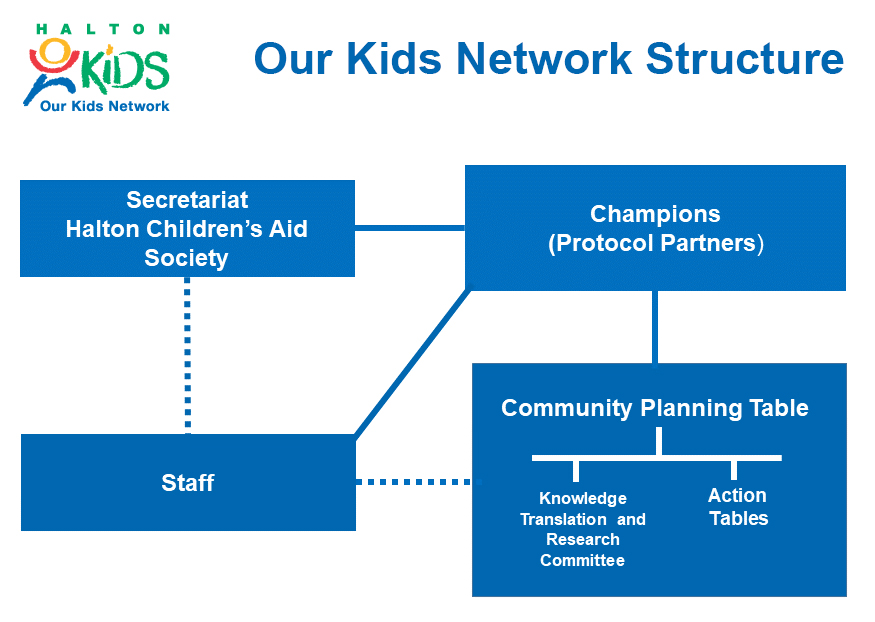
As a cross-sector network, OKN sits at the intersection of data, relationships, and collaboration.
Our role is not only to make data accessible, but to help organizations turn information into shared understanding, informed decision-making, and coordinated action across systems. As shared community infrastructure in Halton, we support organizations to understand what’s happening across the region, align around common priorities, and make more informed decisions together.
OKN is not simply a source of data – it is part of the shared infrastructure that helps Halton’s child and youth sector learn, align, and act more effectively together.
This includes:
- Bringing partners together to explore data and emerging trends
- Supporting shared interpretation and dialogue
- Connecting insights to areas where bringing efforts together is possible
Whether identifying emerging community needs, aligning responses across sectors, or informing local planning, these conversations help organizations move from understanding challenges to acting on them together.
At its core, this work is about moving from fragmented efforts to more connected and aligned responses for children, youth, and families.
In the coming months, OKN will continue to build on this role – strengthening how we support not just access to information, but the processes that help turn insight into action.
Questions to carry forward
As we continue this work:
- Where do we already have common understanding—and how can we build on it to take action together?
- Where might different interpretations of data be creating barriers—and how could we work through them collaboratively?
- What opportunities exist to align efforts across sectors, rather than responding in parallel?
- How can we create more consistent space for shared sense‑making—not just data sharing?
Moving from insight to action is collective work. It takes time, trust, and a willingness to work across boundaries.
If this reflects your experience, OKN would welcome the opportunity to connect.
Why this matters
Children, youth, and families experience systems are interconnected. Their needs do not fall neatly within organizational or sector boundaries.
When we use data collectively, grounded in a mutual view and aligned action, we are better positioned to respond to that reality.
This is the opportunity in front of us.
Contact OKN to explore data together, share what you’re seeing, or identify opportunities to align efforts across Halton.