By: OKN Team
Across Halton, organizations are working hard to support children, youth, and families, as needs become increasingly complex. Resources are stretched, challenges are interconnected, and organizations are being asked to demonstrate impact while working across systems.
Collaboration matters, but the bigger question is how we create the conditions for collaboration to move beyond good intentions and lead to meaningful impact.

The challenges we are trying to solve are interconnected
Children, youth, and families experience life as a whole. Their well-being is influenced by relationships, education, health, housing, community connections, economic circumstances, and many other factors.
As a result, the issues organizations are working to address rarely sit neatly within a single program, sector, or mandate.
Most organizations recognize the need to work together. Yet responding collaboratively can be challenging when:
- Information is dispersed across multiple sources
- Planning happens within organizational boundaries
- Opportunities for cross-sector dialogue are limited
- Resources are focused on immediate priorities
In these circumstances, even organizations pursuing similar goals can find themselves working in parallel rather than in partnership.
Moving from coordination to alignment
Coordination helps organizations stay informed, understand each other’s work and avoid unnecessary duplication.
Alignment goes a step further.
Alignment means developing a shared understanding of community needs, identifying common priorities, and intentionally moving in the same direction while allowing each organization to contribute through its unique role and expertise.
This does not mean everyone does the same thing.
It means organizations can contribute differently toward shared outcomes.
When organizations are aligned, local data becomes more meaningful, planning becomes more strategic, and opportunities for collective impact become easier to identify.
The role of shared infrastructure
Creating alignment requires more than goodwill. It requires infrastructure.
Infrastructure is often thought of as something physical, but communities also rely on shared infrastructure that helps people, organizations, and systems work together.
For Halton’s child and youth sector, that infrastructure includes:
- Reliable information about the experiences and needs of children, youth, and families
- Trusted relationships across organizations and sectors
- Opportunities to come together, learn, and identify shared priorities
- Mechanisms for turning shared understanding into action
When these pieces are in place, collaboration becomes less dependent on individual relationships or short-term initiatives, and communities are better positioned to respond to changing needs and sustain progress.

How OKN helps make this possible
For three decades, OKN has played a unique role in Halton.
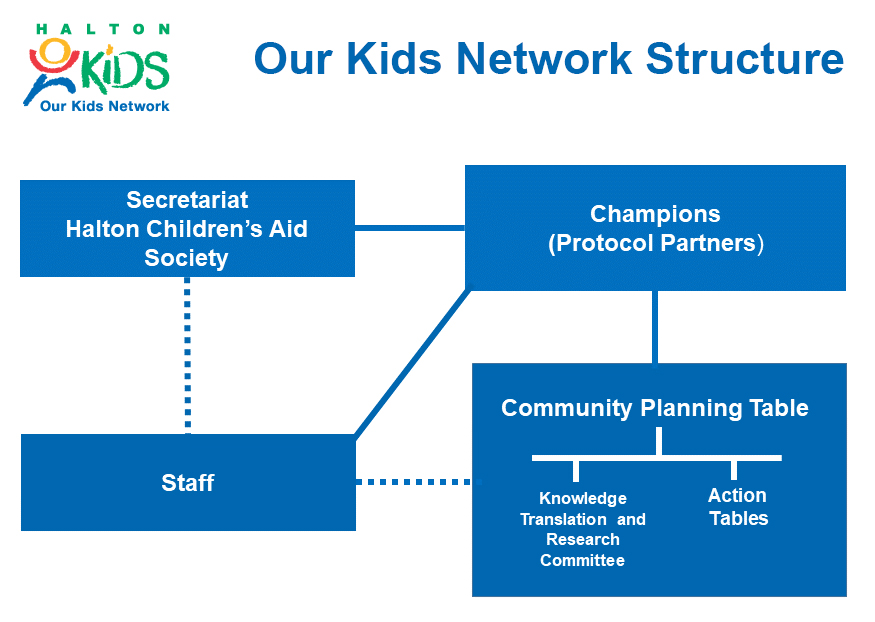
As the region’s dedicated child and youth infrastructure, OKN is focused exclusively on the outcomes, experiences, and needs of children, youth, and families.
We bring together three connected elements:
- Community intelligence
Local data and evidence help organizations understand trends, strengths, gaps, and emerging needs affecting children, youth, and families across Halton.
- System connection
Trusted relationships and cross-sector networks help reduce silos, encourage collaboration, and create opportunities for shared problem-solving.
- Decision support
Practical insight helps organizations strengthen planning, prioritize investments, identify opportunities, and make evidence-informed decisions with confidence.
Together, these elements help move from fragmented efforts toward more coordinated and aligned action.

Consider the issue of screen time among children and youth. Families may be seeing the impact of screen use on sleep, routines, relationships and family life, while schools may be seeing its effects on attention, learning, social interaction and classroom engagement. Health professionals may be focused on physical activity, mental well-being and healthy development, while community organizations may see barriers to creating opportunities for children and youth to connect, play and participate offline. Each perspective provides a different piece of the picture. Local data can help us understand what is happening across Halton, while shared knowledge and conversations across sectors can help identify what is working and where there are gaps. Bringing these perspectives together can help organizations move beyond addressing the issue individually and identify opportunities for more coordinated action.
An evolving approach
As community needs continue to evolve, OKN is evolving as well.
In the coming months, we will be expanding opportunities for partners to connect around shared priorities, explore emerging issues, and use local information to inform collective action.
Our goal is simple: to help create the conditions for organizations to learn from one another, align their efforts, and make informed decisions that strengthen outcomes for children, youth, and families.
A question to carry forward
As we look ahead:
What could we accomplish differently if organizations across Halton had the information, relationships, and opportunities they need to move in the same direction?
If you’re thinking about this question in your own organization or across the broader community, we would welcome the conversation. Whether you’re looking for local data, opportunities to connect with others, or space to explore an emerging issue, OKN can help bring the right people, information, and perspectives together.